Why Founders Struggle to Step Into Leadership
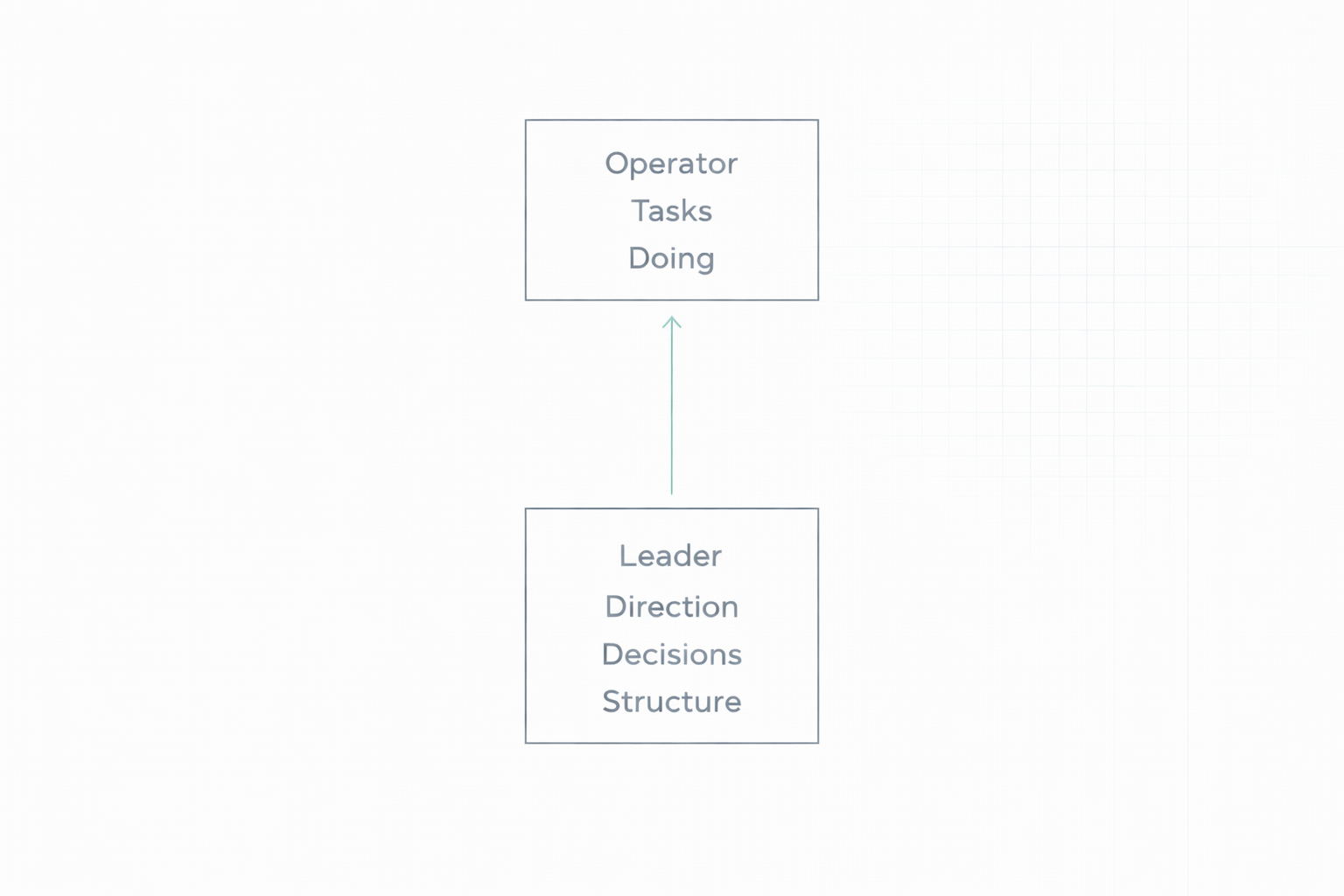
At some point in the life of a growing business, the founder’s role needs to change.
In the early days, the founder does everything.
They solve problems.
They make decisions.
They deliver the work.
That approach works when the business is small.
But as the company grows, something begins to shift.
The business no longer needs a doer.
It needs a leader.
And that transition is far more difficult than most founders expect.
Delegation Alone Doesn’t Solve the Problem
Many founders assume the solution is simple.
Hire more people.
Delegate more work.
Step back from the day-to-day operations.
Yet many founders do exactly that and still feel stuck.
They still get pulled into decisions.
They still feel responsible for everything.
They still find themselves solving problems the team should handle.
The issue isn’t delegation.
The issue is identity.
The Operator Identity
Most founders didn’t begin their journey as leaders.
They began as experts.
They were the person who could:
- solve the problem
- fix the issue
- deliver the result
- step in when things went wrong
Their value came from being capable and dependable.
For a long time, that identity works extremely well.
It’s what allows the business to grow in the first place.
But eventually, the role changes.
The business no longer needs the founder to solve every problem.
It needs the founder to create an environment where problems can be solved without them.
Why Leadership Feels Uncomfortable
Moving from operator to leader often feels like a loss.
The founder stops doing the work they are good at.
They step away from the areas where they used to add obvious value.
Instead of solving problems directly, they are expected to:
- guide decisions
- develop people
- design systems
- tolerate uncertainty
To someone with an operator mindset, this can feel frustrating.
Watching someone do a task imperfectly can feel irresponsible.
So founders step back in.
Just temporarily.
Just to help.
But over time, those small interventions recreate the same dependency the founder was trying to escape.
Leadership Is Not a Promotion
Many people treat the move into leadership as a promotion.
In reality, it often feels like the opposite.
You do less of what you’re good at.
You receive fewer immediate results.
You stop being needed in the same way.
The work becomes less visible and less immediate.
Instead of action, leadership requires:
- judgment
- patience
- restraint
- trust
That shift can be deeply uncomfortable for founders who built their success on being effective doers.
The Question Beneath the Transition
The real challenge beneath this transition is rarely operational.
It is personal.
The question most founders eventually confront is:
Who am I if I’m no longer the one doing the work?
Until that question is answered honestly, structural changes in the business often remain fragile.
Founders may redesign roles and responsibilities, but unconsciously pull work back toward themselves.
Not because they want control.
Because the old identity still feels safer.
What Changes When the Identity Shifts
When the shift into leadership finally happens, the founder’s relationship with the business changes.
They stop measuring their value by output.
They stop reacting to every issue that appears.
Instead, they focus on:
- defining direction
- designing roles
- strengthening decision-making
- building trust within the team
The founder becomes less involved in the daily activity of the business.
But far more influential in its long-term direction.
A Question Worth Asking
If you’re honest with yourself:
Which part of your role would be hardest to let go of?
And why?
The answer often reveals more about the founder’s identity than about the business itself.
And that’s usually where the real leadership transition begins.
If this resonates, the Life Alignment Workshop explores how founders redesign their role, their time, and the structure of the business so leadership becomes sustainable.
-----
When founders remain deeply involved in operations, the pressure quickly spills into the rest of life. That’s one reason many start chasing work-life balance, even though the real challenge is structural. Here’s why work-life balance doesn’t work for founders.