Why Work-Life Balance Doesn’t Work for Founders
If you're a founder still chasing work-life balance, you’ve probably felt the frustration.
You try to switch off, but your mind stays on the business.
You take time away, but decisions follow you.
You work late, then feel guilty.
You rest, then feel behind.
After a while, it starts to feel like you're failing at balance.
You’re not.
The truth is simpler: work-life balance was never designed for founders.
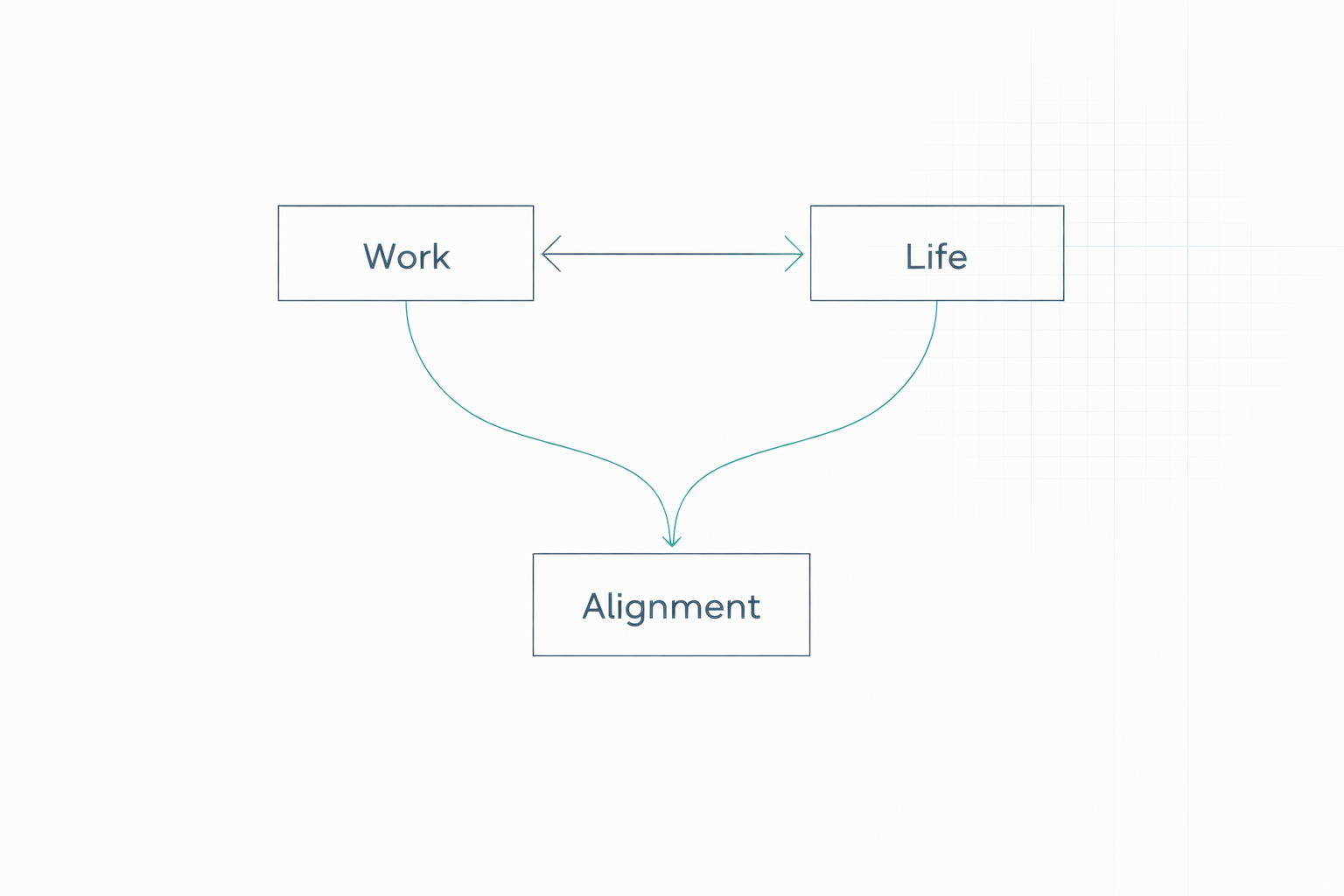
Because when you own a business, work and life are not separate domains that can be neatly balanced on a scale. They are intertwined systems that constantly influence each other.
Trying to separate them often creates more tension, not less.
The Promise of Work-Life Balance
Work-life balance sounds sensible.
Work here.
Life over there.
Keep the two in harmony and everything should work.
But real life rarely behaves like that.
Your business doesn’t stop needing you at 5 pm.
Your brain doesn’t clock off when you close your laptop.
Your life doesn’t politely wait until the next quiet quarter.
So what happens instead?
You try to protect your time.
The business pushes back.
You step away.
Your attention stays half-attached.
You end up feeling present nowhere.
The result isn’t balance.
It’s a constant tug-of-war.
The Real Issue: Most Businesses Aren’t Designed
The real problem isn’t that you’re working too much.
It’s that your business and your life are evolving without deliberate design.
Responsibilities creep in because you're capable.
Meetings get added because they always have been.
Decisions keep coming because no one else owns them yet.
Over time, something subtle happens.
You stop choosing your weeks.
You inherit them.
And eventually, that inherited structure starts shaping your life more than you shape it.
What looks like a work-life balance problem is often a design problem.
Why This Becomes More Expensive as the Business Grows
In the early days, the imbalance feels temporary.
You tell yourself:
“I’ll push through this phase.”
“It won’t always be this intense.”
“This is just the price of growth.”
Sometimes that’s true.
But if the structure of the business never changes, the pressure doesn’t disappear. It simply becomes normal.
The cost rarely shows up immediately in revenue or performance.
It shows up in things like:
- declining energy
- reduced creativity
- constant background pressure
- less presence in the rest of life
The business might still look successful from the outside.
But inside, the experience becomes heavier.
The Shift: From Balance to Alignment
Instead of trying to separate work and life, a more useful question is:
How should the business fit into the life you want to live?
This is where the idea of Life Alignment becomes more helpful than balance.
Alignment accepts something founders already know instinctively:
Your business is part of your life.
So rather than trying to isolate it, the focus becomes designing the relationship between the two.
That means asking better questions:
- What kind of energy do I want most days?
- What does “enough” actually look like for me?
- What role do I want to play in the business now?
- What trade-offs am I no longer willing to make?
These questions aren’t about doing less work.
They’re about doing the right work, in a structure that makes sense for the life you want to live.
Designing a Business That Supports Your Life
A business designed with your life in mind starts to behave differently.
Decisions become clearer.
Boundaries become easier to hold.
Energy becomes more sustainable.
Not because the business becomes easy.
Because it becomes intentional.
Instead of asking:
“How do I squeeze life around the business?”
You start asking:
“How should this business support the life I want to live?”
That single shift changes how you think about growth, leadership, and success.
A Question Worth Asking
Most founders didn’t start a business to feel permanently stretched or behind.
They started because they wanted more freedom, more ownership, and more meaning in their work.
If that’s starting to feel further away than you expected, it’s worth pausing to ask:
Where is my business currently being shaped by default instead of by design?
That question is often the first step toward something better.
If this topic resonates with you, the Life Alignment Workshop explores how founders redesign the relationship between their business, their time, and the life they want to build.
-----
This article is part of the Life Alignment for Founders series, where we explore how business owners can design their work and life deliberately.