You Started a Business for Freedom. So Where Did It Go?
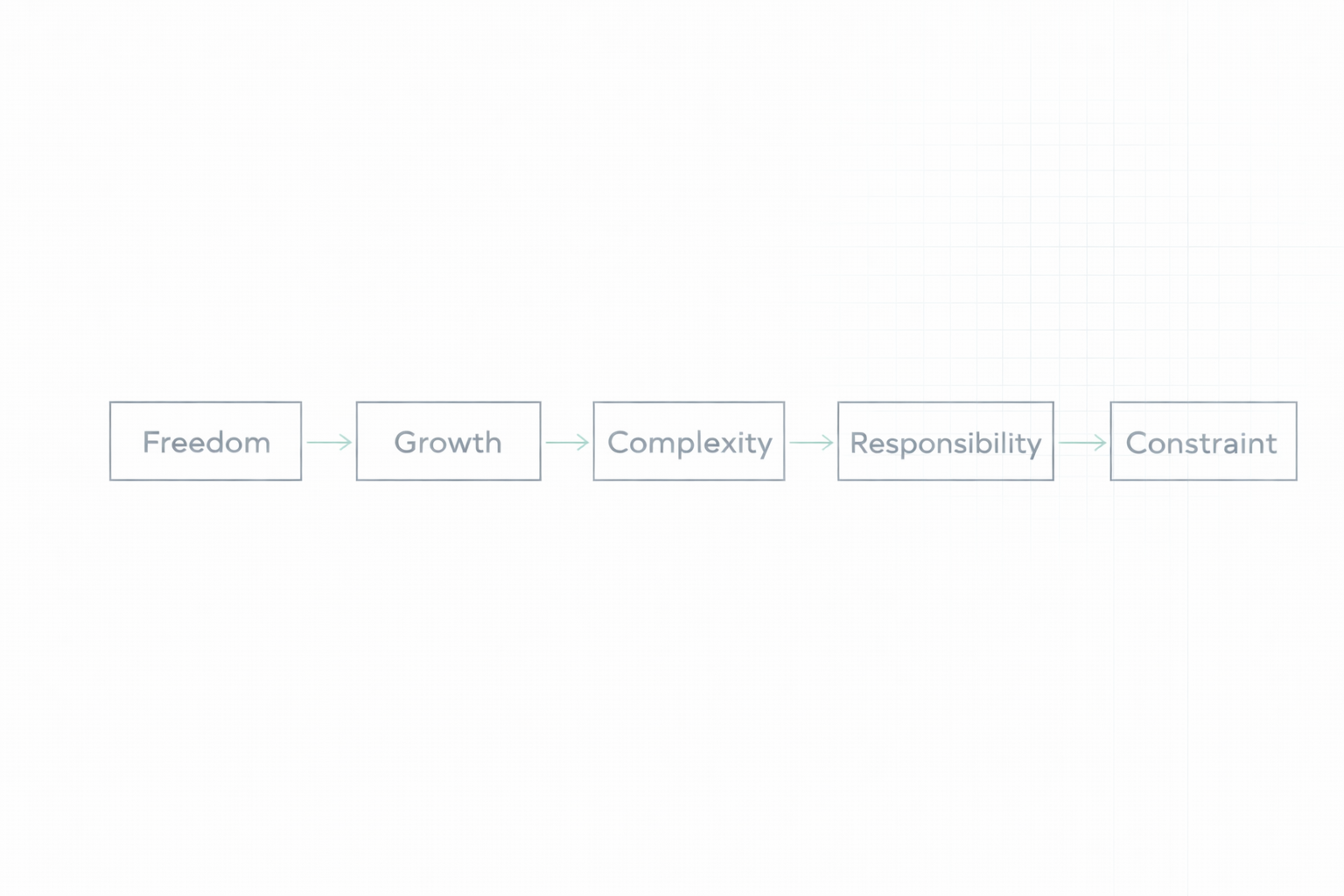
Most people who start a business are chasing some version of freedom.
Not necessarily luxury or early retirement.
Something simpler.
The freedom to decide how they work.
The freedom to choose their direction.
The freedom to build something that belongs to them.
But a few years into the journey, many founders notice something strange.
Instead of feeling freer, they feel more tied to the business than ever.
The calendar is full.
Decisions keep flowing toward them.
Responsibility rarely switches off.
The business is working.
Yet the freedom that motivated it feels further away than expected.
The Three Freedoms Most Founders Want
When founders talk about freedom, they’re usually talking about three things.
Financial freedom
The ability to earn without being capped by a salary.
To be rewarded directly for effort and risk.
Time freedom
The ability to choose when and how they work.
To be present for the parts of life that matter.
Purpose freedom
The ability to build something meaningful.
To work with the clients they choose.
To shape the kind of work they care about.
These freedoms are powerful motivations.
But building a business doesn’t automatically guarantee them.
The Freedom Paradox
In reality, many founders experience the opposite.
Instead of financial security, they feel financially exposed.
Instead of time freedom, they feel permanently available.
Instead of purposeful work, they find themselves managing complexity and responsibility.
From the outside, the business may still look successful.
But inside, something feels different.
More pressure.
More decisions.
More responsibility than expected.
This is what many founders quietly experience as the freedom paradox.
Why Freedom Often Disappears
Freedom doesn’t disappear because founders make mistakes.
It disappears because businesses evolve faster than their structure.
In the early stages, the founder is naturally involved in everything.
They make decisions.
They solve problems.
They hold the standards.
But if the structure of the business doesn’t evolve as it grows, something happens.
The business becomes dependent on the founder.
Every decision flows through them.
Every problem returns to them.
Every important moment requires their involvement.
The founder becomes the centre of the system.
And systems built around a single person rarely create freedom for that person.
Why Stepping Back Often Fails
Many founders eventually try to step back.
They hire more people.
They delegate tasks.
They try to create space.
For a short time, it works.
Then something familiar happens.
Standards wobble.
Decisions slow down.
People start checking in more frequently.
So the founder steps back in to stabilise things.
Not dramatically.
Just enough to help.
But over time, the pattern returns.
Freedom expands briefly, then collapses again.
Freedom Requires Structure
The mistake many founders make is thinking freedom comes from removing themselves.
In reality, freedom comes from replacing themselves properly.
Without clear structure:
- decision-making becomes unclear
- responsibility drifts back to the founder
- teams become dependent again
The founder didn’t create freedom.
They created a vacuum.
And businesses naturally pull the founder back in to fill it.
The Role of Structure
Structure is what makes freedom sustainable.
Clear structure defines:
- who makes which decisions
- what outcomes people own
- what standards look like
- when the founder is not required
This doesn’t make the business rigid.
It makes it stable.
When structure is clear, teams gain confidence and founders gain space.
That space is where freedom begins to return.
A Different Question About Freedom
Most founders eventually ask:
“How do I get more freedom?”
A more useful question is:
What structure would allow this level of freedom to exist?
That question shifts attention from personal effort to business design.
Freedom stops being something the founder chases.
It becomes something the business supports.
A Question Worth Asking
Be honest with yourself.
Where in your business are you still chasing freedom without building the structure to support it?
That’s usually where frustration lives.
And it’s often the first place worth redesigning.
If this resonates, the Life Alignment Workshop explores how founders redesign the relationship between their business, their time, and the life they want to build.
-----
Many founders initially try to fix this by pursuing work-life balance, but the real issue is often deeper than time management. Here’s why work-life balance doesn’t work for founders.