Why Successful Founders Still Feel Exhausted
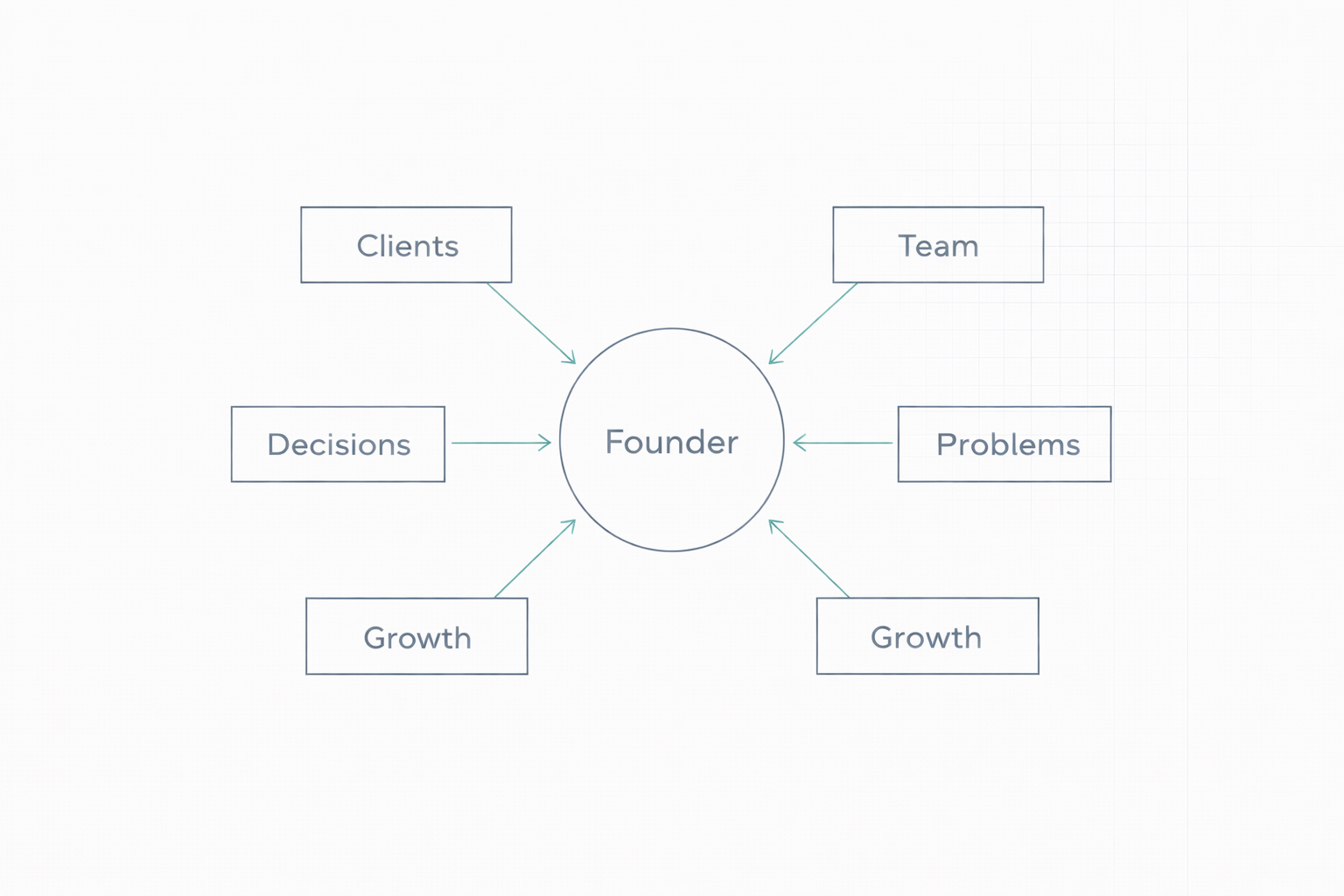
From the outside, everything might look fine.
The business is stable.
Revenue is growing.
The team is capable.
Yet internally, something feels different.
You wake up already tired.
Decisions feel heavier than they used to.
Even when the business is performing well, your energy feels permanently stretched.
Many founders assume something must be wrong with them.
But more often, nothing is wrong with the founder.
The issue sits in the structure of the business and the role the founder still plays inside it.
The Hidden Weight of Running a Business
When people talk about entrepreneurship, they often focus on visible pressures:
- long hours
- financial risk
- responsibility for employees
Those pressures are real.
But there is another layer that rarely gets discussed.
Founders often carry continuous cognitive load.
Even when you’re not actively working, part of your mind is processing:
- future decisions
- potential risks
- unresolved problems
- opportunities that require attention
This background processing never fully switches off.
Over time, it slowly drains energy.
When the Business Grows but the Founder’s Role Doesn’t
In the early stages of a business, this pressure is expected.
You’re building everything from scratch.
You’re solving problems daily.
You’re learning constantly.
But as the business grows, something subtle can happen.
The business evolves.
Your role inside it doesn’t.
You are still:
- the main decision-maker
- the problem solver
- the person everyone turns to when things get stuck
Even when the team is capable, the system still routes responsibility back to you.
That structure creates constant pressure, even if the company itself is healthy.
Why Success Doesn’t Always Reduce Pressure
Many founders expect that growth will eventually make things easier.
Once revenue stabilises.
Once the team grows.
Once operations mature.
But if the business structure still depends heavily on the founder, success can actually increase pressure.
More clients.
More staff.
More complexity.
The founder ends up managing a larger machine without fundamentally changing how the machine runs.
That’s when exhaustion begins to creep in.
Not because the founder isn’t capable.
But because the system still relies too heavily on them.
The Energy Problem Most Founders Don’t See
Energy isn’t only about hours worked.
Two founders can work the same number of hours and feel completely different levels of exhaustion.
The difference often comes down to how much responsibility their role still carries.
When a founder remains the centre of the system, they carry:
- decision fatigue
- responsibility fatigue
- mental context switching
Even if they are technically working fewer hours.
Over time, this creates the feeling many founders recognise:
“I shouldn’t be this tired, but I am.”
The Shift: Redesigning the Founder’s Role
Solving this problem rarely starts with working less.
It starts with redesigning the founder’s role inside the business.
Questions like:
- What decisions should only I make?
- What responsibilities should move to the team?
- Where am I still acting as the operational centre of the business?
These questions often reveal something important.
The exhaustion many founders feel isn’t caused by effort alone.
It’s caused by carrying responsibilities that the business should now be able to absorb.
A Better Question for Founders
Instead of asking:
“How do I get more energy?”
A more useful question is:
What is my business still expecting from me that it should no longer require?
That question often unlocks the real shift.
Because the goal isn’t simply to work less.
It’s to build a business structure where the founder’s role becomes clearer, lighter, and more focused.
When Energy Returns
When founders redesign their role properly, something interesting happens.
Energy returns surprisingly quickly.
Not because the business becomes easier.
But because the founder is no longer carrying every layer of responsibility at once.
Clarity replaces constant pressure.
And work starts to feel purposeful again instead of permanently draining.
If this resonates with you, the Life Alignment Workshop explores how founders redesign the relationship between their business, their time, and their energy.
-----
Many founders try to solve this exhaustion by chasing work-life balance, but that idea rarely works in practice. In this article we explain why work-life balance doesn’t work for founders.